News & Updates
Community Solar vs. Third-Party Supply (Retail Energy)
Ampion Renewable Energy
|
September 10, 2026

As electricity prices rise around the country, more and more utility customers are realizing that there are other energy options that can save them money. When researching other electricity options, you may encounter terms like "third-party supply," (a.k.a. "retail energy" or "competitive energy supply") and "Community Solar."
While third-party supply and Community Solar both relate to your electric bill, they represent different models of financial savings. Understanding these differences is key to optimizing your utility costs and supporting renewable energy goals.
What’s the difference between Community Solar and third-party supply?
Third-party supply and Community Solar can both affect what you pay for electricity—but they work very differently.
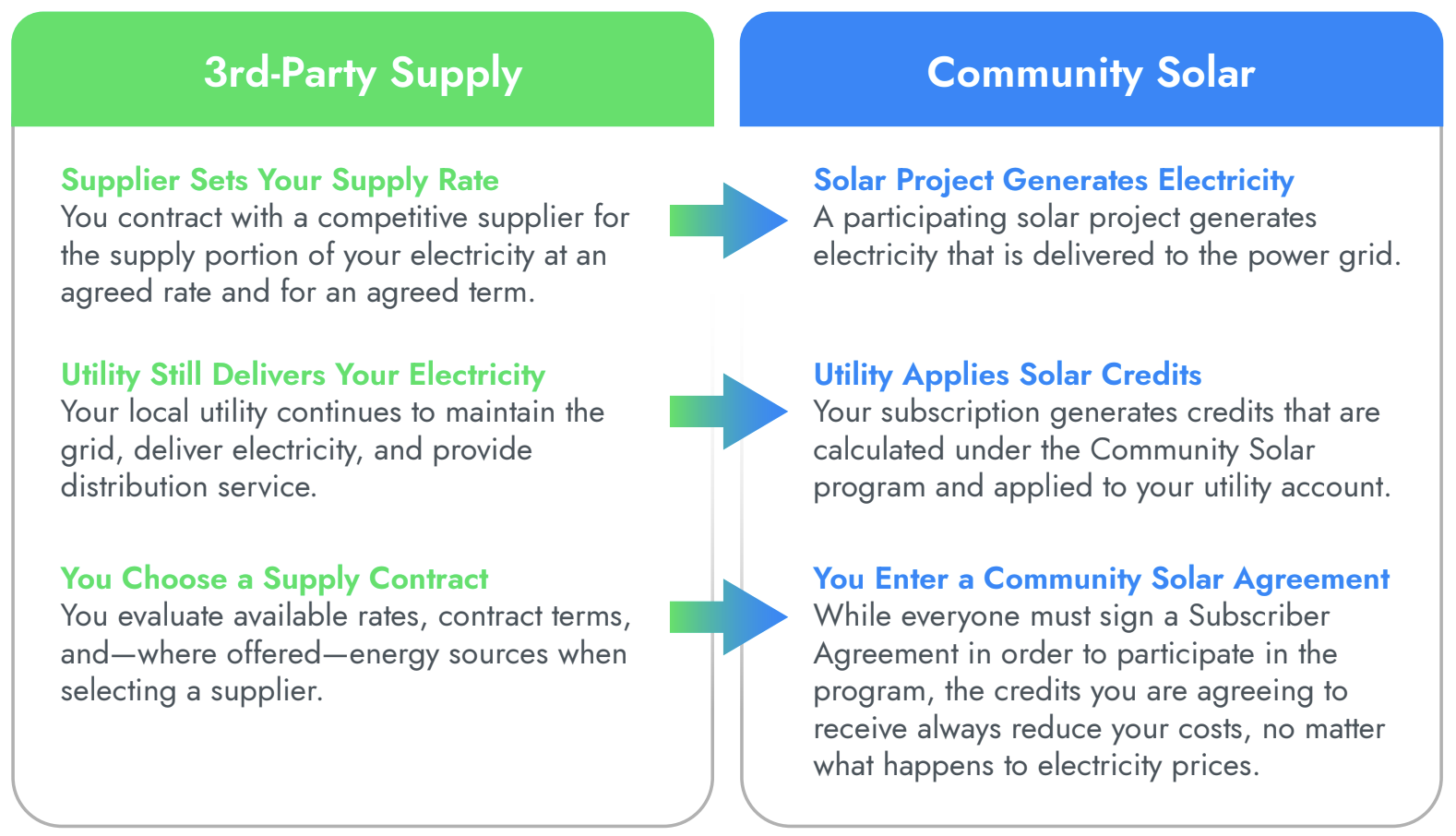
With third-party supply, you choose a competitive electricity supplier and agree to a contracted supply rate, typically for a set term. That rate may ultimately be higher or lower than prevailing utility or market rates during the life of the contract.
Community Solar is different. It does not replace your electricity supplier or change your supply rate. It is a state-supported program that typically works alongside your existing utility and supply arrangement, providing bill credits based on your subscription to a local solar project.
What to Consider with Third-Party Supply
A third-party supplier, also known as a retail or competitive energy supplier, provides the supply portion of your electricity instead of your utility's standard supply service.
You Lock in a Supply Rate
Your contract establishes the cost per kilowatt-hour for electricity supply. Depending on how the market changes over time, that contracted rate could be better or worse than the Standard Offer Rate, the default supply rate available through your utility.
You Commit to a Contract Term
Supply contracts are often multiple years in duration. You’re committed to those rates and terms for the length of the agreement. If lower-priced options become available through the Standard Offer or other suppliers, you may not be able to terminate your contract early.
Renewable Energy Is Not Guaranteed
Choosing a third-party supplier does not necessarily mean your electricity is being sourced from renewable energy. Renewable or green energy attributes must be specifically included in the supply product or agreement.
How is Community Solar different?

Community Solar operates outside the traditional retail supply setup on your utility bill. Rather than replacing your supplier, it is a state program that allows you to subscribe to a solar project and receive utility credits associated with that subscription.
Works Alongside Your Existing Supply
Community Solar typically sits alongside your existing utility or third-party supply arrangement. You do not need to select a new electricity supplier in order to participate.
Bill Credits, Not a New Supply Rate
Instead of establishing a new $/kWh electricity supply rate, Community Solar provides credits that are calculated under the applicable state program and applied to your utility account. This allows you to save regardless of whether utility prices go up or down over time. In either case, your Community Solar credits reduce the total you pay for your electricity.
Supports Solar Generation
Your subscription is tied to electricity produced by a solar project participating in the state’s Community Solar program.
Community Solar doesn't replace your electricity supply strategy—it complements it. By subscribing through Ampion, you can receive savings through solar bill credits while keeping your existing utility and supply arrangement in place.